What Is Emotional Flooding?
Emotional flooding occurs when the brain and body perceive a conversation as threatening. The nervous system shifts into survival mode, making it difficult to think clearly, listen effectively, or communicate with empathy.
Although emotional flooding can happen to anyone, many men have been socialized to suppress vulnerable emotions rather than recognize and express them. As a result, they may not realize they’re flooded until they’re already reacting.
During emotional flooding, the body may experience:
- A racing heart
- Tightness in the chest or jaw
- Rapid, shallow breathing
- Muscle tension
- An overwhelming urge to defend, argue, withdraw, or escape
These reactions aren’t signs of weakness. They’re signs that the nervous system is overloaded.
When people imagine emotional flooding, they often picture explosive arguments. But for many men, flooding looks much quieter.
A man might become defensive; might start explaining instead of listening; might begin searching for errors in what she’s saying instead of trying to understand what she means; might withdraw completely, hoping the conversation will simply end.
From the outside, it can look like indifference.
Inside the man’s body its a different story – his heart rate has increased; his muscles have tightened; his mind is racing. Without realizing it, his brain has shifted from connection to self-protection.
When the brain detects threat, it prioritizes protection over connection.
This often leads to predictable communication patterns:
- Interrupting instead of listening
- Explaining instead of understanding
- Becoming defensive
- Focusing on proving facts rather than addressing feelings
- Shutting down emotionally
- Walking away without resolving the issue
Unfortunately, these protective behaviors often increase their partner’s frustration, creating a cycle where both people feel misunderstood.
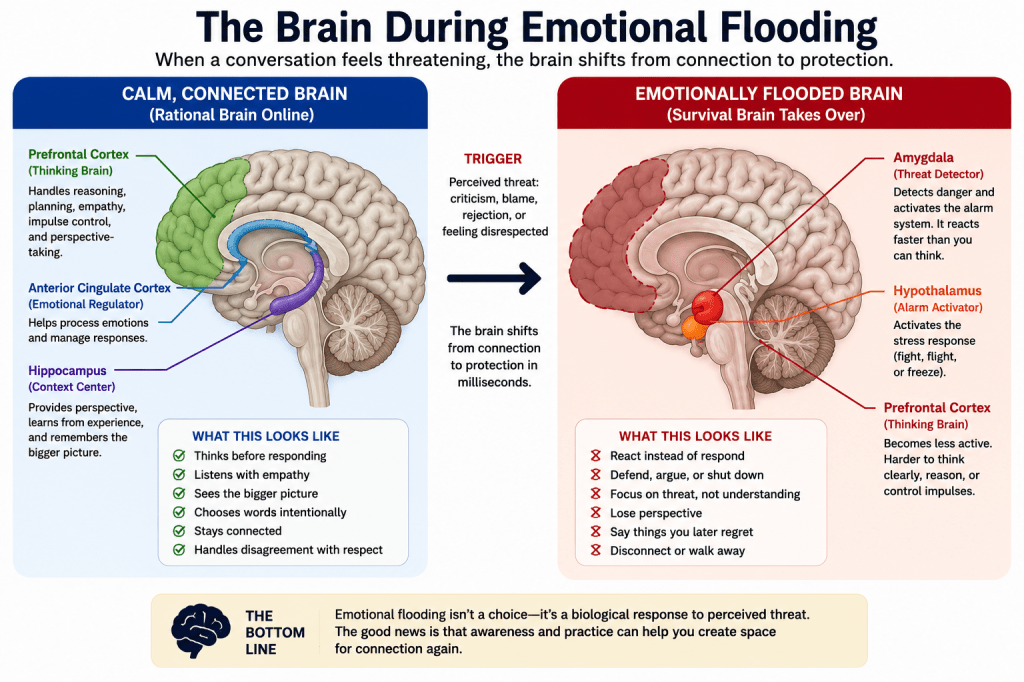
From a neuroscience perspective, during emotional flooding the brain’s threat detection system begins to overpower its reasoning system.
The amygdala, an almond-shaped structure deep within the brain, which is constantly scanning for danger signals the hypothalamus to activate the sympathetic nervous system, releasing stress hormones such as adrenaline (epinephrine) and cortisol. Heart rate increases, breathing becomes shallower, muscles tense, and the body prepares to fight, flee, or freeze. At the same time, activity in the prefrontal cortex—the part of the brain responsible for judgment, impulse control and empathy becomes less effective. In other words, the emotional brain becomes louder while the rational brain becomes quieter. During this state, a person is more likely to interrupt, become defensive, misinterpret a partner’s intentions, or shut down altogether.
The CBT Perspective: Thoughts Drive Reactions
Cognitive Behavioral Therapy (CBT) teaches that our interpretation of a situation often determines our emotional response.
During conflict, men frequently have automatic thoughts such as:
- “I’m being attacked.”
- “Nothing I say will be good enough.”
- “She’s trying to control me.”
- “If I admit I’m wrong, I’ll lose.”
These thoughts may arise so quickly that they feel like facts.
Once they take hold, the conversation shifts from solving a problem together to protecting oneself from perceived danger.
Learning to identify these automatic thoughts creates space to ask a different question:
“Is this conversation actually dangerous, or does it simply feel uncomfortable?”
That small shift can dramatically change how a conversation unfolds.
How to Recognize Flooding Before It Takes Over
One of the most valuable relationship skills is learning to notice flooding early.
Ask yourself:
- Is my heart racing?
- Am I listening, or just preparing my response?
- Am I trying to understand, or am I trying to win?
- Do I suddenly feel like I need to escape this conversation?
If the answer to several of these questions is yes, you’re probably flooded.
That awareness allows you to pause before saying something you’ll later regret.
Emotional Maturity Isn’t About Never Getting Flooded
Even people in healthy, satisfying marriages become emotionally flooded.
The difference isn’t whether it happens.
The difference is what happens next.
Emotionally mature partners recognize when they’re overwhelmed, take responsibility for regulating themselves, and return to the conversation with curiosity instead of defensiveness.
That is a skill—not a personality trait.
How Counseling Can Help
Many men were never taught how to identify emotions, regulate stress during conflict, or communicate without becoming defensive. These are learnable skills.
Individual counseling can help you recognize the thoughts and physiological reactions that lead to emotional flooding, while couples counseling provides a structured environment to practice new ways of communicating before destructive patterns become entrenched.
Learning to manage emotional flooding doesn’t mean becoming less masculine or less confident. It means developing the emotional competence to stay present during difficult conversations—one of the strongest predictors of trust, intimacy, and long-term relationship satisfaction.


You must be logged in to post a comment.